

Many people use sedatives to sleep after using stimulants, but mixing these drugs creates dangerous and unpredictable reactions.
Research shows that combining zolpidem and cocaine can mask sedation, lead to complex sleep behaviors, and increase the risk of serious injury or overdose.
This article explains the specific dangers and immediate side effects of this combination.
How Often Do People Mix Ambien and Cocaine?
Understanding how frequently people combine these substances requires looking at different types of data.
While national surveys track drug use broadly, they do not always publish specific numbers for every drug combination.
However, evidence from emergency departments and interviews with users reveals that this pairing is a known health risk.
Evidence from National Surveys
The National Survey on Drug Use and Health (NSDUH) collects data on substance use across the United States.
This survey uses a method called ACASI methodology to allow people to answer sensitive questions privately.
While the survey tracks cocaine use and sedative misuse, standard public reports do not list the specific percentage of people who mix ambien and cocaine.
Researchers know that people who misuse sedatives often take other substances. For example, data indicates that among people who misuse tranquilizers or sedatives, a large majority also use other drugs.
This suggests that while the exact number of people mixing ambien and cocaine is not published in summary tables, it occurs within a broader pattern of polysubstance use.
Emergency Department Data
Hospitals collect detailed information when patients arrive with drug-related health issues. The Drug Abuse Warning Network (DAWN) records emergency department visits and can identify multiple drugs in a single visit.
The DAWN series documentation shows that the system captures specific pairings, including zolpidem and cocaine.
Although public reports often focus on the most common drugs like alcohol or opioids, the underlying data confirms that these combinations lead to emergency visits.
The lack of a widely publicized statistic reflects how the data is reported, not an absence of the problem. Emergency department records remain a key tool for understanding the severe outcomes of mixing these drugs.
Real-World Patterns of Use
Recent studies provide a clearer picture of why and how people mix these substances. Interviews with people who use drugs reveal a specific pattern where sedatives are used to “come down” after using stimulants.
A qualitative study published in 2025 describes users taking benzodiazepines or Z-drugs (like Ambien) at night to sleep after using cocaine or ketamine.
This “functional” use is distinct from binge patterns. In the functional pattern, the goal is often to switch off the stimulant effects to get rest.
However, in heavier binge patterns, users may take higher doses of sedatives throughout the day. This increases the risk of overdose and profound confusion.
Immediate Side Effects of Cocaine and Ambien
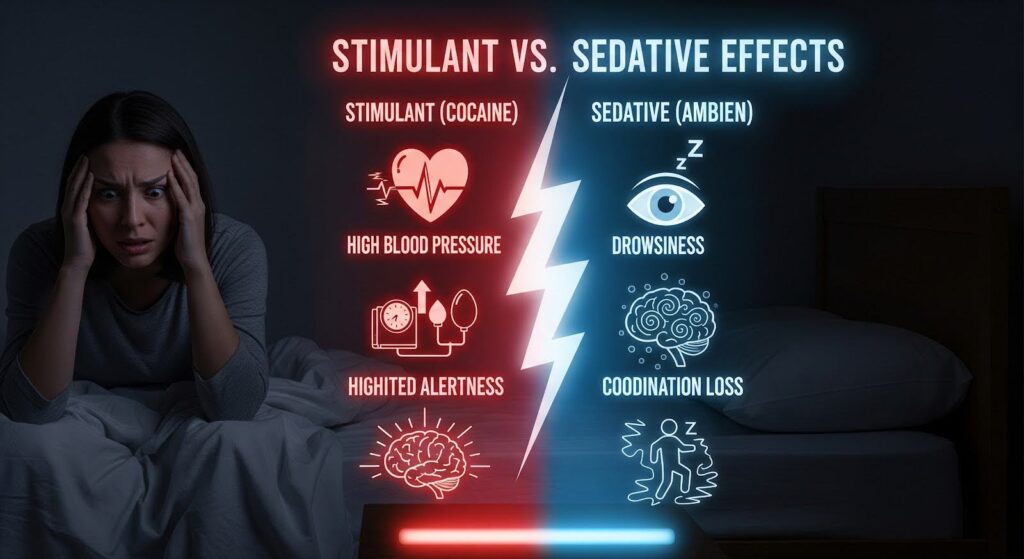
The physical and mental effects of mixing cocaine and ambien can be severe. Cocaine is a stimulant that speeds up the body, while Ambien (zolpidem) is a sedative designed to slow brain activity for sleep.
When taken together or close in time, they create conflicting signals in the body.
The Danger of Masking Effects
One of the primary risks of mixing stimulants and sedatives is the masking effect. Cocaine can hide the feeling of sedation that Ambien normally causes.
A person might take a normal dose of Ambien but feel like it is not working because of the lingering stimulation from cocaine.
This often leads to dose escalation, where the user takes more Ambien to force sleep. Once the cocaine wears off, which happens relatively quickly, the high dose of zolpidem can take over, leading to deep sedation or respiratory issues.
This dynamic is a known factor in polysubstance harms and accidental overdoses.
Complex Sleep Behaviors
Zolpidem carries a serious warning regarding complex sleep behaviors. These are activities that people perform while they are not fully awake, such as sleep-walking, sleep-driving, preparing food, or making phone calls.
The FDA labeling for zolpidem mandates that patients stop taking the drug immediately if these behaviors occur.
When cocaine is added to the mix, the risk of injury increases. Cocaine can cause agitation and disinhibition, while Ambien causes amnesia and confusion.
A person may engage in risky behaviors without any memory of them the next day. This combination of energy and lack of awareness can lead to falls, accidents, and dangerous situations.
Cardiovascular and Physical Risks
Cocaine places significant stress on the heart, causing rapid heart rate and high blood pressure. While zolpidem is generally not a heart stimulant, the combination of drugs puts the body under strain.
Medical literature notes rare cases of bradycardia (slow heart rate) associated with benzodiazepine and Z-drug overdose.
In a polysubstance context, the body must manage the competing effects of a strong stimulant and a hypnotic sedative.
This can complicate medical treatment if a person arrives at the emergency room, as they may fluctuate between agitation and unresponsiveness.
Understanding the Risks of Ambien and Cocaine
The mixture of ambien and cocaine presents unique risks compared to other drug combinations.
While combinations like opioids and sedatives are more commonly associated with fatal respiratory failure, the stimulant-sedative mix creates a specific profile of behavioral and physical danger.
The “Comedown” Trap
Many users fall into a cycle of using stimulants for energy and sedatives for sleep. This is often described as a “comedown” or “landing gear” strategy.
The Harm Reduction Journal notes that while some users view this as a functional way to manage sleep, it introduces new risks.
The transition from a stimulant high to a sedative-induced sleep is not always smooth. The residual effects of cocaine can prevent the Ambien from working as intended, leading to a state of confused wakefulness.
This state is particularly prone to the complex sleep behaviors mentioned earlier.
Overdose and Polysubstance Dangers
Toxicology reviews show that severe zolpidem intoxications frequently involve other substances. While fatal overdoses solely from zolpidem are rare, the risk rises sharply when it is mixed with other drugs.
The Z-trip review highlights that some users even misuse zolpidem to seek paradoxical stimulant-like effects, sometimes alongside cocaine.
This suggests that for some subgroups, the combination is not just about sleep but about altering the high.
These patterns are associated with higher risks of toxicity and emergency medical needs.
Comparison of Effects
The following table outlines how the effects of these drugs differ when taken alone versus when they are combined.
| Feature | Cocaine (Acute) | Zolpidem (Acute) | Combined Risks |
| Primary Effect | Euphoria, alertness, agitation | Sedation, sleep induction | Conflicting signals; masked sedation |
| Behavioral Risk | Impulsivity, anxiety, panic | Amnesia, complex sleep behaviors | High risk of injury due to agitated confusion |
| Physical Impact | Rapid heart rate, high blood pressure | Slowed responses, motor impairment | Strain on cardiovascular system; falls |
| Overdose Risk | Hyperthermia, heart failure | Respiratory depression (rare alone) | Escalated dose risk; unpredictable toxicity |
Medical and Legal Implications
The medical community and federal agencies have established clear warnings regarding zolpidem.
These warnings are critical for anyone considering the use of ambien and cocaine together.
FDA Warnings
The Food and Drug Administration (FDA) requires a Boxed Warning for zolpidem products. This is the highest safety-related warning assigned by the FDA.
It highlights the risk of complex sleep behaviors that can result in serious injury or death. The FDA Zolpidem SPL states that these behaviors can occur after just one dose.
Because cocaine can impair judgment and increase risk-taking, the likelihood of ignoring these warning signs increases.
Users may not realize they are experiencing a complex sleep behavior until an injury has already occurred.

What Clinicians Recommend?
Doctors and addiction specialists advise against mixing sedatives with stimulants. Clinicians are trained to screen patients for substance use before prescribing sleep aids.
If a patient is using cocaine, prescribing Ambien is generally considered unsafe due to the interaction risks.
For acute exposures or suspected overdoses involving this combination, Poison Control offers confidential guidance.
They can help determine if a situation requires immediate emergency room care or if it can be managed safely at home.
Why Does It Matter?
The combination of ambien and cocaine is more than just a sleep aid strategy; it is a significant health hazard.
The immediate risks include injury from sleep-walking or sleep-driving, while the longer-term risks involve a cycle of dependence on uppers and downers to function.
The masking effect can lead users to take dangerous amounts of medication without realizing it, turning a functional attempt to sleep into a medical emergency.
If you or someone you know is relying on substances to manage energy and sleep, professional support can help break the cycle. MARR’s dedicated addiction treatment program can provide the safety and structure needed to recover.
